
Groundwork
Lunging your horse safely
Tania Greenwood · 2 July 2026 · 8 min read
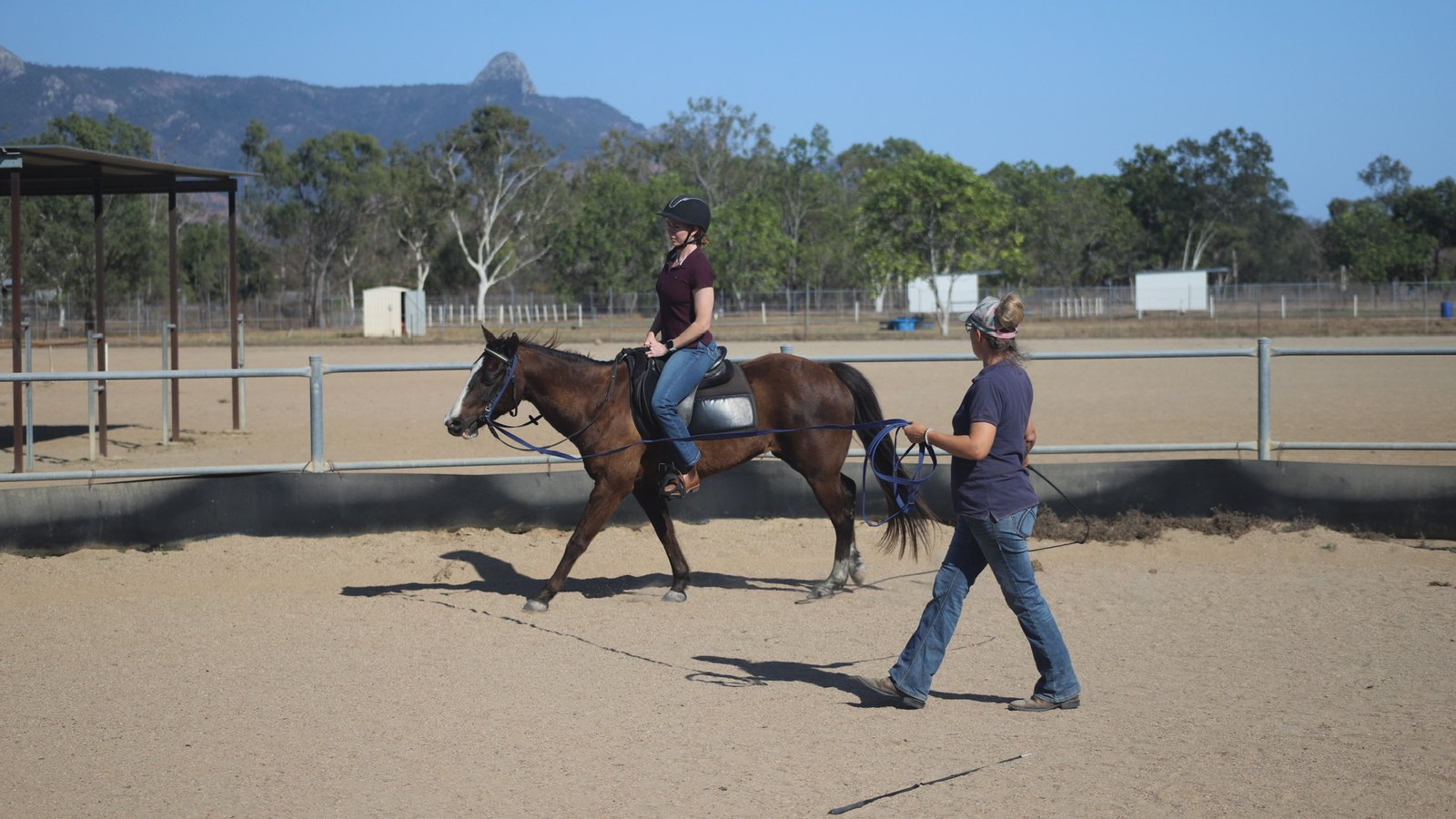
Lunging looks like the simplest thing in the world until you are standing in the middle of it. Most of what goes wrong is position, not the horse.
Lunging is one of those skills that looks completely straightforward from the fence. The horse goes round, you stand in the middle, and that appears to be the whole of it.
Then you have a go, and within about ninety seconds you are being towed sideways by a horse who has decided the circle is now twenty-five metres wide and located somewhere near the gate.
I want to say something before any of the rest of it. Lunging is the piece of groundwork most likely to hurt somebody, because you are attached by a long line to a large animal who is moving fast, and the failure mode is that the line runs through your hand or wraps around some part of you. Everything below is worth knowing, and none of it substitutes for having someone with you the first few times. That is not me being cautious for the sake of it. It is the honest answer.
What you need, and what you should not use
A lunge cavesson, a well-fitted headcollar, or a bridle. A cavesson is worth knowing about, because lunging off one means you are steering from his nose rather than through the bit.
If you are using a bridle, run the lunge line through the inside bit ring, over the poll, and clip it to the outside bit ring. Keep the line flat and not twisted. Clipping it to the outside ring rather than straight to the inside one is what stops the bit being pulled through his mouth or pressing unevenly, and running it over the poll adds a little poll pressure that helps him stay balanced and straight.
A proper lunge line. Long, flat, and in one piece. Not a lead rope, not two things clipped together.
A lunge whip. It is not for hitting the horse and it very rarely touches him. It is an extension of your arm that lets you point at the part of him you are talking to.
Gloves. Every single time. This is the one I will not be talked out of. A line running through a bare hand takes skin off in well under a second, and the reflex to grab is faster than the decision to let go.
Boots you can move in, and a helmet. Plenty of people lunge without a helmet. I would rather you did not.
What I would avoid while you are learning: side reins and any other gadget. They change what the horse can do with his head and neck, and adding them before your own position is reliable means two things are going wrong at once and you cannot tell which.
Where to stand, which is most of it
Here is the thing that makes lunging click, and it is almost never explained properly.
You are not standing in the middle of a circle. You are moving on a small circle of your own, staying level with the horse's girth, holding a triangle: the line to his head is one side, the whip pointing at his hindquarters is another, and his body is the third.
From there:
- Ahead of his girth slows him or turns him in. You are in front of the movement, so you are blocking it.
- Behind his girth, towards the hip, sends him forward. You are driving.
- Level with the girth is neutral, and neutral is where you want to live.
Almost every lunging problem I get asked about is a position problem wearing a costume. A horse falling in is usually a person who has drifted behind him. A horse who will not go forward is usually a person standing slightly in front without realising.
Getting started
Walk him out to the circle and let him look about first. A horse who has not been allowed to see where he is will spend the first five minutes finding out anyway, at speed.
Start at walk. Ask him out onto the circle by stepping towards his hip and pointing the whip low, behind him. Feed the line out gradually rather than letting him go straight to the end of it.
Keep the line with a light, even contact. Not tight, and not looped on the ground where he or you can stand on it. Whatever slack you are not using stays folded in your hand in loops you could drop instantly. Never wound around your hand.
Walk for a couple of minutes each way before you ask for trot. He is warming up and so are his joints.
The size of the circle
A circle of about 15 to 20 metres is a reasonable working size for most horses.
Smaller is not gentler. A tight circle at trot puts real, repeated load on the inside joints, and the smaller it gets the harder that becomes, particularly on a young horse, an unfit one or one coming back from time off. If a horse pulls the circle small, that is worth looking at rather than accepting.
Keep the sessions short. Fifteen to twenty minutes of actual work, changing direction regularly, is plenty for most horses. Lunging is deceptively hard work, and because you are standing still it is very easy to overdo without noticing. Twice as long does not make it twice as useful.
Changing direction
Bring him to a halt on the circle. Walk to him, rather than reeling him in towards you. Sort the line out. Then set him up the other way.
It sounds fussy and it is worth doing properly. A horse who learns that the end of one direction means a scramble in the middle learns to anticipate, and an anticipating horse on a lunge line is how people get stood on.
Most horses are noticeably better one way than the other, exactly like most riders. That is normal and it is useful information about where the work is.
What good lunging actually looks like
This is the part that separates lunging from just making the horse go round.
You are looking for a horse tracking evenly on the arc of the circle, with his body bent gently along it rather than his neck cranked in and his shoulder falling out. You want a consistent rhythm you could count. You want his inside ear on you, checking in, while the rest of him gets on with the job.
You are also, and this is the useful bit, watching him move without a rider on him. That is not a small thing. A lot of what you feel from the saddle is easier to see from the ground, and lunging is one of the few times you get a proper look at your own horse in motion.
If something looks uneven or different from usual, stop. That is a conversation for your vet rather than something to work through. I am a coach, and telling the difference between a soundness problem and a training problem is exactly where my job ends and theirs begins.
The most common mistakes
- Walking a big circle yourself. If you are covering ground, he is towing you. Shrink your own circle back down.
- Gripping the line. A soft, even contact you can give and take on. Not a tug of war, which he will win.
- Too fast for too long. Rushing is not working. A horse belting round on the forehand is getting fitter at doing exactly that.
- Using the whip like a punishment. Point with it. Raise it. If he ignores the raise, a flick of the lash on the ground behind him is a louder version of the same sentence. It is a voice, not a consequence.
- Lunging on unsuitable ground. Deep, hard or slippery all make a circle worse than a straight line does. If you would not trot him on it, do not lunge him on it.
Frequently asked questions
How long should I lunge for? Fifteen to twenty minutes of work for a horse in normal condition, split between both directions. Less if he is young, unfit or coming back from a break. Lunging is harder than it looks from where you are standing.
Can I lunge instead of riding? For a session here and there, yes, and it has real value: it lets you see how he is moving and it works him without the complication of your weight. As a permanent substitute it is not ideal, because a circle at the end of a line is a narrow kind of work to build a horse on.
My horse just runs. What do I do? Usually the answer is smaller and slower rather than firmer. Bring it back to walk, get the walk genuinely established in both directions over several sessions, and only ask for trot when the walk is boring. Running is very often a horse who does not yet understand the question.
Do I need side reins? Not to learn on, and I would leave them off until your position and timing are consistent. They change what he can do with his head and neck, and adding that while you are still working out where to stand means you cannot tell which part is causing what.
Is lunging bad for a horse's legs? It can be, done small, fast, long or on poor ground. Sensible sized circles, sensible durations and good footing make it a normal part of a horse's work rather than a risk to it.
Keep reading
Horsemanship
Learning to read your horse
He's telling you something on every ride. Most of what looks like a training problem is a conversation you haven't learned to hear yet.
Before your lesson
What to have ready before I arrive
A short, practical checklist for your first mobile lesson, so the hour goes on riding rather than on sorting things out.
Coaching that comes to you
On your own horse, at your own place, across Townsville and surrounds.