
Schooling at home
Pole work you can do at home
Tania Greenwood · 15 July 2026 · 6 min read
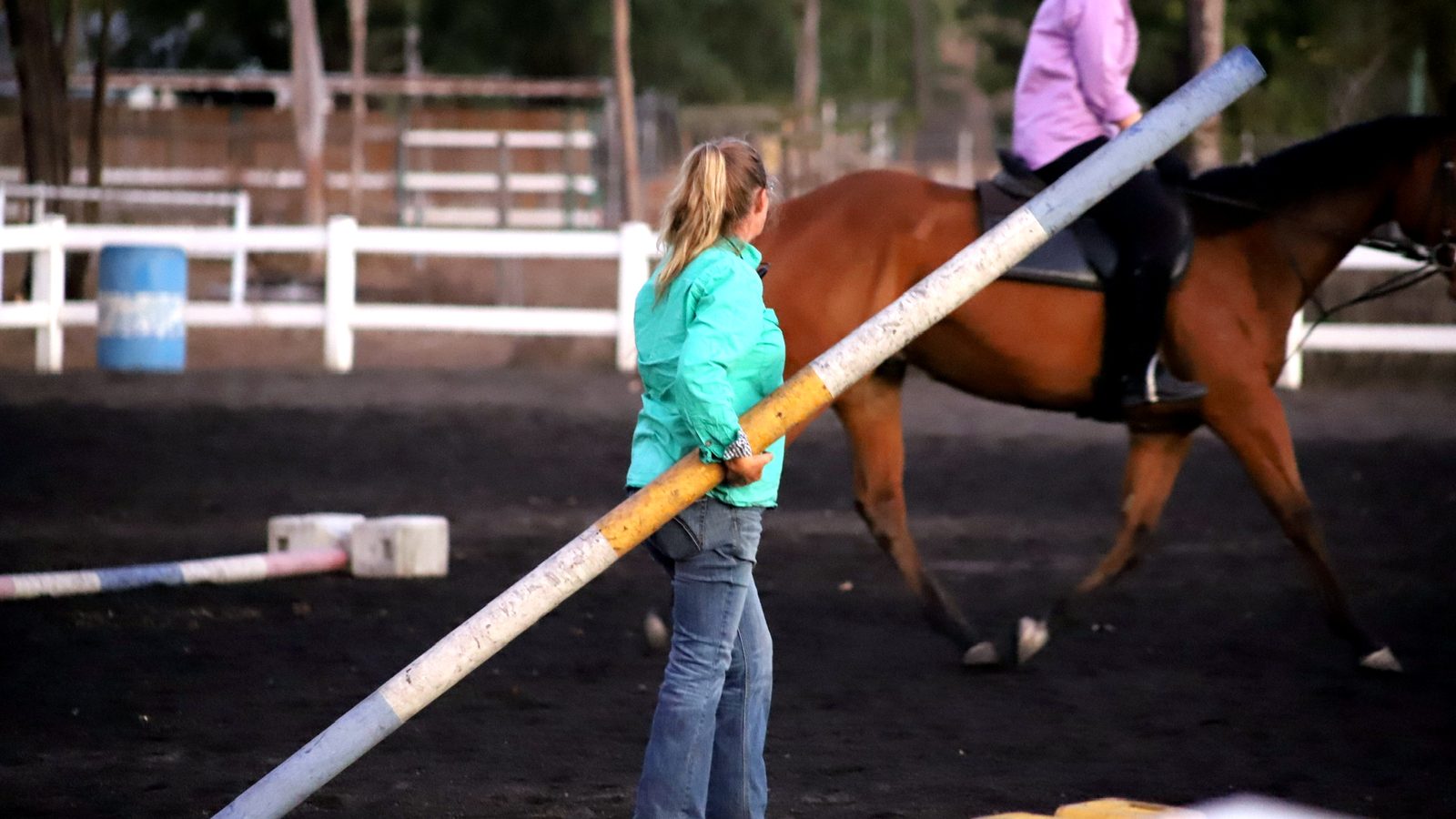
Four poles and a flat patch of ground will give you more useful schooling than most people get out of a full arena, if you know what each exercise is asking for.
Pole work is the best value schooling there is for someone riding at home.
It needs almost nothing. It works on grass. It improves rhythm, straightness, balance and where the horse is looking, all without you having to nag about any of them, because the poles do the asking and the horse works out the answer.
And crucially for the kind of riding this business is built around, it does not need an arena. A reasonably flat, safe patch of paddock and four poles will do.
Before you start
Use proper poles if you can. Solid, round, heavy enough to stay put. Lightweight plastic ones roll when clipped, which teaches a horse that poles move, and that is a lesson you will spend a long time undoing.
Check the ground. Level, not slippery, not deep. Poles ask a horse to pick his feet up and put them down accurately, and he cannot do that on ground he does not trust.
Walk the line yourself first. Genuinely. Walk the approach you intend to ride, and see whether it is actually straight and whether you have left yourself enough room to get organised.
Let him look. Lead him over them, or walk him past on a long rein. A horse who has seen the poles is not a horse who is surprised by them at trot.
The distances
These are starting points, not rules. Every horse has his own stride, and a 15hh cob and a 16.3hh warmblood will not use the same numbers.
| Pace | Rough distance between poles |
|---|---|
| Walk | 0.8 to 0.9 m |
| Trot | 1.2 to 1.4 m |
| Canter | 3.0 to 3.5 m |
Set them, ride through once, then adjust. If he is stretching to reach them, shorten. If he is shuffling or putting in a short step, lengthen. The right distance is the one where his rhythm does not change, and you will feel that far more reliably than you will measure it.
Do not chase the number. A pole distance that is technically correct and wrong for your horse just teaches him that poles are awkward.
Start with one pole
I know. One pole feels like it cannot possibly be worth setting up.
It is the exercise I use most, and almost everyone skips it.
Put a single pole down and ride over it. Walk first, then trot. Ride over the centre of it, straight, in the same rhythm you had before it and the same rhythm after it.
That is the entire exercise, and it is harder than it sounds. Watch for:
- Drifting. Most horses have a side they slide towards. A single pole makes that immediately visible because you can see which part of it you crossed.
- Changing pace. Rushing at it or backing off it both count. You want him to meet it as though it is not there.
- You. Riders look down at the pole, which drops a shoulder and changes the weight. Look up and at where you are going after it.
Ride it from both directions, and off both reins. If your horse is straightforward over it one way and not the other, you have learned something useful about him for the cost of one pole.
Four in a row
Once a single pole is boring, set four in a line at your trot distance.
This is the classic exercise and it is popular for a reason: it asks for rhythm and even steps four times in a row, which is much harder to fake than doing it once.
Ride it in a steady working trot, straight down the middle. Rising or sitting both work. Keep your hands soft and allow his head and neck to move, because he needs them to balance and a fixed hand takes that away from him.
What you are looking for: the same sound. Four even beats, unhurried. If you close your eyes on the approach you can nearly hear whether it worked.
Six passes is plenty. Poles are harder work than they look, and a tired horse starts hitting them, which is not the note to finish on.
The fan
Set four poles on a curve, fanning out from a centre point, so the spacing is short at the inside end and long at the outside end.
Now you have a whole set of exercises from one setup. Ride the inside line for shorter steps, the middle for normal, the outside for longer. Same poles, different question, and the horse has to genuinely adjust rather than being kicked into a bigger stride.
This is the one that makes people go "oh". Being able to lengthen and shorten without changing rhythm is a real skill, and a fan teaches it far better than being told to lengthen down a long side.
Ride it in walk first. The steering is fiddlier than it looks.
The square, or four poles in a box
Put four poles in a large square with a gap at each corner, and use them as things to ride around, between and over.
It does not look like an exercise. What it does is give you accurate points to ride to in an open paddock, which is exactly what you do not have when you are not in an arena. Turn at that pole. Halt level with that one. Leg yield from this one to that one.
If you have read the piece on what the letters in a dressage arena mean, this is the poor relation of the same idea, and it works for the same reason: riding to a fixed point makes you plan.
How to use pole work without ruining it
Little and often. Ten minutes inside a normal schooling session, a couple of times a week. Poles are not a workout to be completed.
Stop while it is good. The temptation after a really nice pass is to do it again to make sure. Do not. That is the moment to walk off on a long rein and let it be the last thing he remembers.
Do not drill. If it is going wrong repeatedly, the answer is almost never another attempt. It is usually the distance, occasionally the ground, sometimes the approach, and quite often the rider being tense about it.
Watch what he does with his head and neck. A horse working over poles properly will usually lower and stretch a bit, because he is looking at where he is putting his feet. That stretch is one of the things you came for. Let him have it.
Frequently asked questions
How many poles do I need to start? One. Genuinely. Four covers everything in this piece and is a sensible thing to own.
What if my horse keeps hitting the poles? Check the distance first, before anything else. Then check the ground and your approach line. Persistent hitting in a horse who was fine last week is worth mentioning to your vet rather than schooling through.
Can I do pole work on grass? Yes. It needs to be reasonably flat and not slippery. Heavy poles matter more on grass because uneven ground makes light ones shift.
Is pole work the same as jumping? No. Poles are flat on the ground and the horse trots or canters over them rather than jumping. It is useful preparation for jumping, but it stands completely on its own for a rider with no interest in jumping at all.
How often is too often? Every session, every time, is too much. It is physical work and it asks for concentration. Twice a week inside your normal riding is a good rhythm.
Keep reading
Progress
How to improve your riding, one percent at a time
Why small, well-managed gains beat waiting for a breakthrough, and what one percent actually looks like in a lesson.
On your own horse
Why lessons on your own horse are worth it
What changes when you learn on the horse you actually ride, at the place you actually keep him.
Coaching that comes to you
On your own horse, at your own place, across Townsville and surrounds.